

Blog
Mayo Scissors: Straight vs Curved, Uses and Care Guide

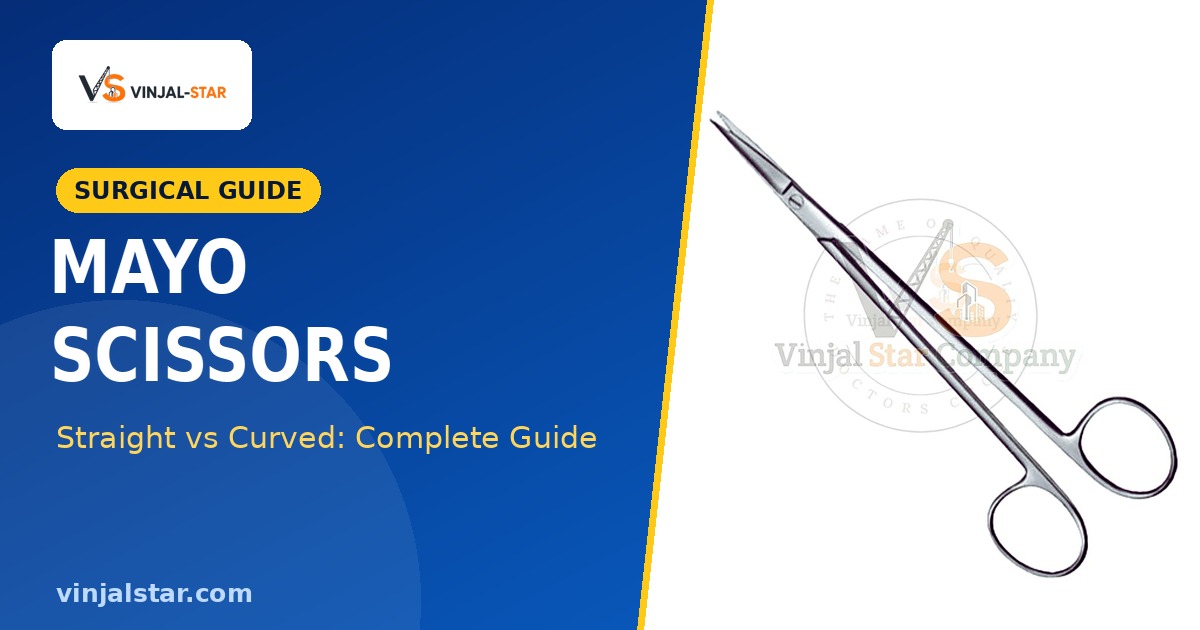
Quick answer: Mayo scissors are heavy-duty surgical scissors for cutting tissue and sutures. Straight blades work on surface tissue and sutures, curved blades follow body contours in deeper fields. The choice between them shapes how cleanly a surgeon dissects, so most theatres stock both.
What Are Mayo Dissecting Scissors?
Mayo scissors are among the strongest scissors in the instrument set. Their thick blades and long handles give the power to cut dense tissue, fascia and sutures without flexing. They come in straight and curved patterns and in standard and heavy (Hegar) builds.
Our Mayo dissecting scissors, straight pattern, are a staple of general, gynecology and orthopedic sets.
Straight vs Curved: The Real Difference
- Straight Mayo scissors: Best for cutting sutures, drains and surface tissue, and for work on the instrument table side of the field. The straight profile gives precise, visible cuts.
- Curved Mayo scissors: The blade arc follows tissue planes and body contours, making them the choice for deeper dissection, undermining skin flaps and cutting around structures.
In practice, surgeons reach for straight blades when they can see the tip clearly, and curved blades when the cut must follow a curve they can feel more than see.
Sizes and Build Options
Mayo scissors are commonly supplied in lengths from about 14 cm to 23 cm. Shorter patterns serve finer work and smaller hands; longer patterns reach deep cavities. Tungsten carbide edged versions (often with one gold ring) hold their edge far longer and are worth choosing for high-volume theatres. Supercut variants, with one razor-serrated blade, grip tissue as they cut and suit delicate dissection.
What Mayo Scissors Should Not Cut
Mayo scissors are built for tissue and sutures, not for wire, drains with metal cores, or bandages. Using them on hard materials nicks the edge and ruins the fine cutting action. Bandage scissors and wire cutters exist for those tasks, and keeping each instrument to its job extends the life of the whole set.
How to Choose Mayo Scissors
- Stock both straight and curved; they are complements, not substitutes.
- Pick length by surgical field depth: 17 cm is the common all-round size.
- Choose tungsten carbide edges for longevity in busy theatres.
- Test the action: blades should glide with light, even tension and meet cleanly at the tips.
Care and Sharpening
Clean and dry scissors promptly, autoclave them open, and keep the pivot lubricated. Dull or loose scissors crush tissue instead of cutting it and should be professionally sharpened or replaced. Never test sharpness on gauze packaging or drapes; use proper test material.
Frequently Asked Questions
What are Mayo scissors used for?
Cutting tissue, fascia and sutures in general, gynecology, orthopedic and many other procedures. They are dissecting scissors, stronger than Metzenbaum scissors.
Which is better, straight or curved Mayo scissors?
Neither is better overall. Straight suits surface work and sutures; curved suits deeper, contour-following dissection. Sets normally include both.
What is the difference between Mayo and Metzenbaum scissors?
Mayo scissors are heavier with thicker blades for dense tissue. Metzenbaum scissors are lighter and finer, designed for delicate tissue.
How long do Mayo scissors stay sharp?
With correct use and care, quality stainless or tungsten carbide scissors serve for years. Dullness usually comes from cutting unsuitable materials.
Buy Mayo Scissors Wholesale
Vinjal Star Manufacturing produces scissors and full instrument ranges in Sialkot, Pakistan under an ISO 13485:2016 quality system. View our Mayo dissecting scissors (straight), or contact us on WhatsApp at +92 346 3594812 for hospital and distributor pricing.
Sources: Surgical scissors, Wikipedia