

Blog
Surgical Scissors: Complete Types and Uses Guide

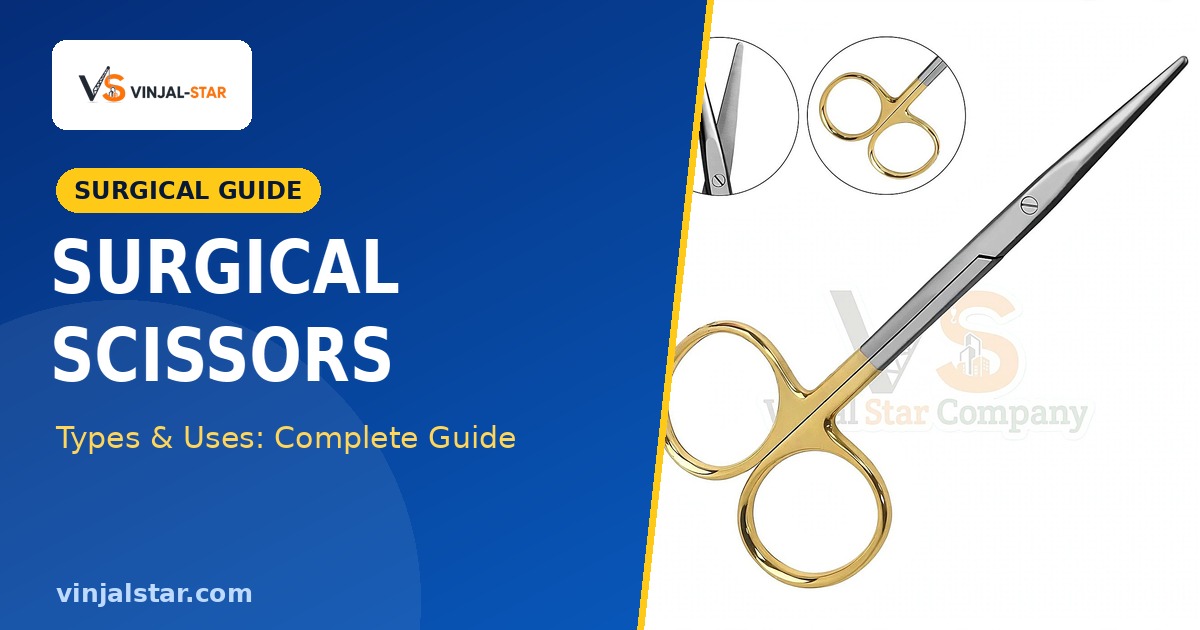
Quick answer: Surgical scissors are not one instrument. They are a family of patterns, each built for a specific material: heavy Mayo scissors for fascia and sutures, fine Metzenbaum scissors for delicate tissue, small iris scissors for ophthalmic and fine work, and suture scissors for cutting thread only. The right choice is pattern first, then straight or curved blades, then the edge type.
What Are Surgical Scissors?
Surgical scissors are precision cutting instruments used in operating theatres, procedure rooms, wards and sterile supply departments worldwide. Unlike household scissors, they are ground, balanced and finished for a specific cutting job, and their performance depends on matching that job: scissors designed for delicate tissue are ruined quickly if used on heavy dressings, and heavy scissors crush delicate tissue.
Scissors in a surgical set fall into broad work types. Tissue scissors cut living tissue. Dissecting scissors have fine blades that both cut and separate tissue planes. Suture scissors cut thread and nothing else. Bandage and dressing scissors cut material on or near the patient. This guide covers the main tissue and dissecting patterns that appear in general, gynecology, plastic and ophthalmic sets.
At Vinjal Star Manufacturing we produce these patterns in Sialkot, Pakistan, the city that supplies a large share of the world’s hand-held surgical instruments. One of our most requested patterns is the TC Metzenbaum scissors (5.75 inch, straight), a good example of how edge technology and pattern combine.
The Main Types of Surgical Scissors
Mayo Scissors
Mayo scissors are the heavy workhorses of the general set. They have thick blades and strong handles and are built for cutting fascia, muscle layers, heavy tissue and sutures. Mayo-Hegar pattern scissors are shorter and heavier still. Straight Mayo scissors are traditionally used for cutting sutures and dressings on the surface; curved Mayo scissors follow tissue planes and are used deeper in the wound. Because of their strength, Mayo scissors are the pattern most often damaged by misuse in reverse: they cut almost anything, so staff reach for them for everything, including jobs that blunt them.
Metzenbaum Scissors
Metzenbaum scissors are finer and lighter than Mayo, with longer handles relative to blade length. They are designed for cutting and dissecting delicate tissue such as bowel serosa, thin fascia and subcutaneous layers. The long handle-to-blade ratio gives the surgeon control rather than force. Metzenbaum scissors should never be used to cut sutures; a single suture cut can nick the fine blades and end their useful life for tissue work.
Iris Scissors
Iris scissors are small, sharp scissors originally designed for ophthalmic surgery. They are used for fine, precise cutting in eye, plastic, vascular and pediatric work, and for delicate suture removal. Their small size (typically around 11 cm) and fine points make them unsuitable for anything heavy.
Tenotomy Scissors
Tenotomy scissors, such as the Stevens pattern, are longer and finer than iris scissors, with narrow blades used for dissecting and cutting delicate structures in ophthalmic, plastic and neurosurgical fields. They are precision instruments and are handled and stored separately in many departments.
Suture Scissors
Suture scissors, including Spencer and Northbent patterns, exist to cut thread. Many have a small hook or notch on one blade that slides under a suture and lifts it away from the skin before cutting. They are deliberately kept separate from tissue scissors so the fine tissue edges are never dulled on thread.
Potts, DeBakey and Specialty Vascular Scissors
Vascular scissors such as Potts-Smith have angled fine blades for opening and trimming blood vessels during vascular and cardiothoracic surgery. They are small in number in most hospitals but critical in their sets, and they are among the most delicate scissors in the catalogue.
Comparison Table
| Pattern | Build | Main use | Should not cut |
|---|---|---|---|
| Mayo | Heavy, thick blades | Fascia, heavy tissue, sutures | Delicate fine tissue |
| Metzenbaum | Fine, long handles | Delicate tissue, dissection | Sutures, dressings |
| Iris | Small, sharp points | Ophthalmic, fine work | Any heavy material |
| Tenotomy | Long, very fine | Delicate dissection | Sutures, heavy tissue |
| Suture (Spencer) | Notched blade | Thread only | Tissue |
Straight or Curved Blades?
Straight scissors are conventionally used on surfaces: cutting sutures, dressings and material in full view. Curved scissors are used in the wound: the curve follows anatomical planes, keeps the surgeon’s hand out of the line of sight, and lets the tips be seen at depth. Most tissue patterns are stocked in both forms, and set lists usually specify the split.
Edge Types: Standard, Tungsten Carbide and Supercut
- Standard stainless edges are the baseline: good for general work, lowest cost.
- Tungsten carbide (TC) edges have carbide inserts brazed into the blades. They stay sharp far longer and are the standard choice for busy theatres. TC instruments are identified by gold-coloured handles in most catalogues.
- Supercut edges have one blade ground to a razor-style micro-serrated profile that grips tissue instead of pushing it. Supercut scissors cut with noticeably less force but the fine edge is for tissue only.
- TC plus Supercut combines both, which is the specification of the TC Metzenbaum scissors linked above and a popular premium configuration for dissecting patterns.
How to Choose the Right Surgical Scissors
- Match the pattern to the material first: tissue type, suture, or dressing.
- Choose straight blades for surface work and curved blades for in-wound work.
- Pick the length that reaches the working depth without excess; common Mayo and Metzenbaum lengths run from about 14 cm to 23 cm.
- For high-volume theatres, specify TC edges to extend service life; for delicate dissecting patterns, add Supercut.
- Protect the investment in the set list: label tissue scissors clearly, keep suture scissors separate, and brief staff that Metzenbaum scissors never cut thread.
Anatomy of a Pair of Scissors
Every pair has the same basic build: two blades joined at a screw or box pivot, two shanks, and two finger rings. Quality shows in the details. The pivot should be tight with no sideways play, the blades should meet along their full length and close with a smooth, even feel, and the cutting action should shear from pivot to tip without a gap at any point. A simple test at goods-in is to cut a single layer of fine tissue paper or a latex glove tip at the very tips of the blades: good scissors cut cleanly at the tip; worn or poorly ground scissors fold the material instead.
Care, Sharpening and Common Failures
Most scissor failures are handling failures. Instruments are damaged by being dropped, by cutting material they were not built for, by autoclaving with blades locked open against other instruments, and by cleaning delays that let soil dry in the pivot. Scissors can be professionally re-sharpened and re-set, and TC inserts extend the interval between services. Sets should be inspected under the standard theatre routine, with any pair that folds dressings, fails the tip test, or shows pivot play removed from service.
Frequently Asked Questions
What is the difference between Mayo and Metzenbaum scissors?
Mayo scissors are heavy and built for fascia, strong tissue and sutures. Metzenbaum scissors are finer, with longer handles, and are built only for delicate tissue cutting and dissection.
What are tungsten carbide scissors?
Scissors with carbide inserts in the blades. They hold an edge much longer than standard stainless steel and are usually identified by gold-coloured ring handles.
Why should Metzenbaum scissors not cut sutures?
Their blades are fine and ground for delicate tissue. Suture material nicks and dulls them quickly, after which they tear tissue instead of cutting it.
What does Supercut mean?
One blade carries a razor-style micro-serrated edge that grips tissue as it cuts, so less force is needed. Supercut edges are for tissue only.
Which scissors are used to remove stitches?
Suture scissors such as the Spencer pattern, whose notched blade slides under the thread and lifts it clear of the skin before cutting.
Buy Surgical Scissors Wholesale
Vinjal Star Manufacturing produces Mayo, Metzenbaum, iris, tenotomy and suture scissors in standard, TC and Supercut specifications, in Sialkot, Pakistan, under CE MDR 2017/745 requirements with ISO 13485:2016 and ISO 9001:2015 quality systems. See the TC Metzenbaum scissors and our iris scissors, or message us on WhatsApp at +92 346 3594812 for wholesale, OEM and distributor enquiries.
Sources: Surgical scissors, Wikipedia.