

Blog
Bandage Scissors: Types and Safe Use Guide

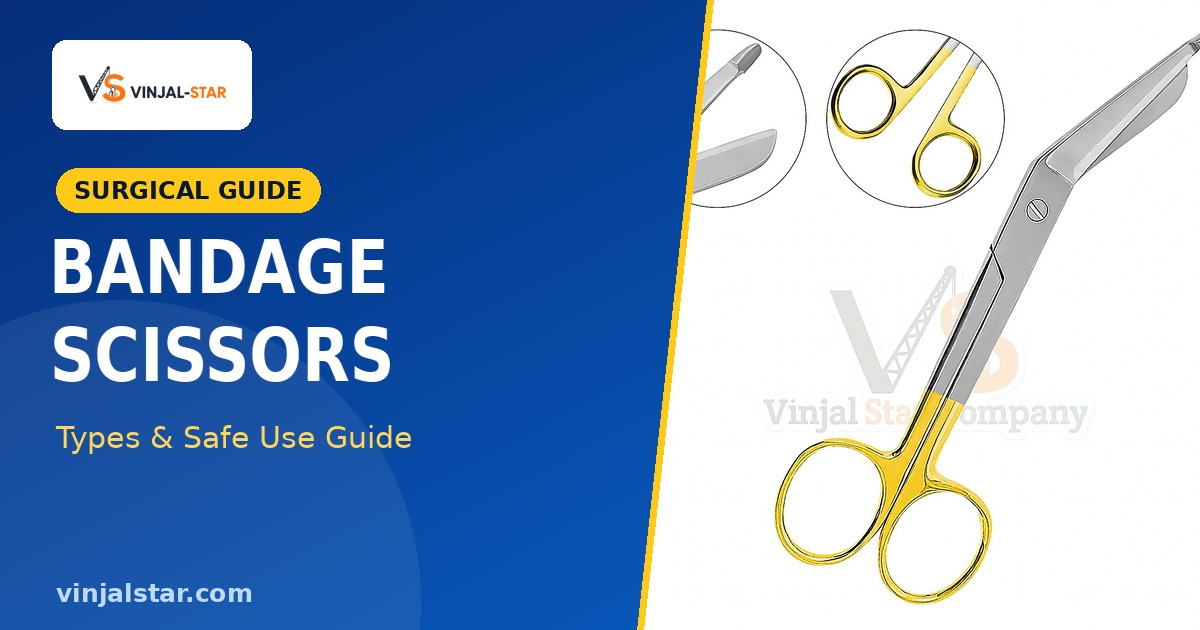
Quick answer: Bandage scissors are safety cutting tools with one flat, blunt probe blade that slides between a bandage and the skin, and one serrated cutting blade. The classic type is the Lister bandage scissor. Other types include EMT trauma shears, Knowles scissors and gauze scissors. They are used to remove dressings and cut clothing without cutting the patient, and the technique that makes them safe is as important as the instrument itself.
What Are Bandage Scissors?
Bandage scissors solve one problem: how to cut material that is wrapped tightly against a person’s skin without injuring them. The answer is in the blade shape. The lower blade is flattened and ends in a blunt, slightly upturned probe tip, wider than a normal scissor blade. Slid flat against the skin under a bandage, it lifts the bandage away from the skin and shields the skin completely. The upper blade, usually finely serrated, then cuts down onto the flat blade rather than toward the patient.
The pattern everyone meets first is the Lister bandage scissor (5.5 inch), the standard size in dressing packs, district nurse bags and hospital wards worldwide.
The Types of Bandage Scissors
Lister Bandage Scissors
The original and most common pattern, named after Joseph Lister. One probe blade, one serrated blade, ring handles. Lister scissors come in a range of sizes for different work: around 3.5 inch (9 cm) for small dressings and pediatric use, 4.5 inch (11.5 cm), the all-purpose 5.5 inch (14 cm), and larger 7.25 inch (18.5 cm) versions for heavy dressings, plaster-adjacent work and veterinary use.
EMT and Paramedic Trauma Shears
Trauma shears are the heavy-duty emergency relative: larger, thicker blades, often with a flattened lower blade in the same protective principle, plastic-coated handles and sometimes a serrated edge aggressive enough to cut clothing, seatbelts and thin metal. They live in first response kits, ambulances and emergency departments. They are cutting tools for speed, not precision, and are not a substitute for Lister scissors at the bedside.
Knowles Bandage Scissors
Knowles scissors are a lighter, more delicate variant in which both blades are slimmer, used for finer dressing work and for cutting light bandages where the heavy Lister probe is more than needed.
Gauze and Dressing Scissors
Straight general-purpose scissors with one serrated blade, often sold as gauze scissors, are used on the trolley to cut gauze, tape and dressing material before application. They are not probe-bladed, so they are not the tool for cutting a bandage that is already on the patient; that job belongs to the Lister pattern.
Utility and Bandage Scissors With One Serrated Edge
Many ward and clinic patterns combine the probe blade with features such as an offset handle to keep the hand clear of the patient, or a flattened lower ring for a carabiner in emergency kits. The defining feature is unchanged: flat probe below, cutting blade above.
Comparison Table
| Type | Key feature | Main use |
|---|---|---|
| Lister | Flat probe blade, serrated top blade | Removing dressings on the patient |
| Trauma shears / EMT | Heavy blades, big handles | Clothing, emergency cutting |
| Knowles | Slim, delicate blades | Fine dressing work |
| Gauze scissors | Straight, one serrated blade | Cutting material off the patient |
Sizes Explained
Bandage scissors are specified by overall length. The common Lister sizes are 3.5 inch (about 9 cm), 4.5 inch (11.5 cm), 5.5 inch (14 cm) and 7.25 inch (18.5 cm). The 5.5 inch size is the default because it balances control and leverage for everyday dressings. Smaller sizes give precision for fingers, toes and children. The largest sizes give leverage on multilayer and padded dressings. When ordering for a department, state the size in both inches and centimetres; suppliers list both, and confusion between 5.5 inch and 5.5 cm is a real and common ordering error.
How to Use Bandage Scissors Safely: Step by Step
- Wash hands and prepare. Follow your local dressing protocol; explain to the patient what you are doing.
- Choose a gap. Find or create a small opening at the edge of the bandage, away from any wound, drain or bony prominence.
- Insert the probe flat. Slide the flat blade under the bandage with the probe lying flat against the skin, pointing in the direction you intend to cut. The probe must stay in contact with the skin, not ride up into the dressing.
- Keep the flat blade down. As you cut, angle the scissors so the probe presses gently toward the patient and lifts the bandage away; the cutting blade closes onto the probe, never toward the skin.
- Cut in a straight line away from the wound. Work along the limb, not across it, and never cut blindly over an area you cannot see or feel with the probe.
- Support the limb and check the skin. Once the bandage is open, remove it in layers, watching for adhered inner dressings; stuck layers are soaked off, not cut off.
- Inspect and clean the scissors. Check the blades for damage, and clean and sterilise or dispose according to the instrument type and local policy.
Safety Rules That Matter
- Never use tissue scissors or standard scissors to remove a bandage on a patient.
- Never force a probe under a bandage that will not admit it; soften, soak or cut at a different edge.
- Be extra careful over bony areas, in confused patients and children, and where the skin is fragile, thin or broken.
- If a dressing is adhered to a wound, stop: cutting harder is how skin gets cut.
- Keep one dedicated pair for dressing removal so the probe edge stays smooth; a burred or damaged probe can scratch.
Care and Reprocessing
Reusable Lister scissors are simple, robust instruments. Their enemy is misuse as a general tool: opening packaging, cutting wire and prising lids all burr the probe and bend the blades. Clean after use, check that the blades close smoothly with no gap, and remove from service any pair whose probe tip is bent or rough. Disposable bandage scissors in sterile dressing packs are single-use and should never be reprocessed.
Frequently Asked Questions
Why do bandage scissors have a flat blade?
The flat probe blade slides against the skin, lifts the bandage clear and acts as a shield, so the cutting blade can only cut the bandage, not the patient.
What size bandage scissors should I buy?
5.5 inch (14 cm) Lister scissors are the all-purpose standard. Add 3.5 or 4.5 inch for fine work and 7.25 inch for heavy dressings.
Can bandage scissors cut clothing?
Lister scissors cut light clothing in an emergency, but trauma shears are the right tool for clothing, belts and boots.
What is the difference between bandage scissors and trauma shears?
Bandage scissors are precision instruments with a probe blade for work against the skin. Trauma shears are heavy emergency cutters built for speed on clothing and materials.
Are bandage scissors left- or right-handed?
Most patterns are effectively ambidextrous in light use; dedicated left-hand versions exist and are worth stocking for left-handed staff.
Buy Bandage Scissors Wholesale
Vinjal Star Manufacturing produces Lister bandage scissors in 3.5, 4.5, 5.5 and 7.25 inch sizes, plus trauma shears and dressing scissors, in Sialkot, Pakistan, under CE MDR 2017/745, ISO 13485:2016 and ISO 9001:2015. See the Lister bandage scissor 5.5 inch, or message us on WhatsApp at +92 346 3594812 for clinical, distributor and dressing-pack enquiries.
Sources: Bandage scissors, Wikipedia.