

Blog
Bone Rongeurs: Types, Uses and Buying Guide

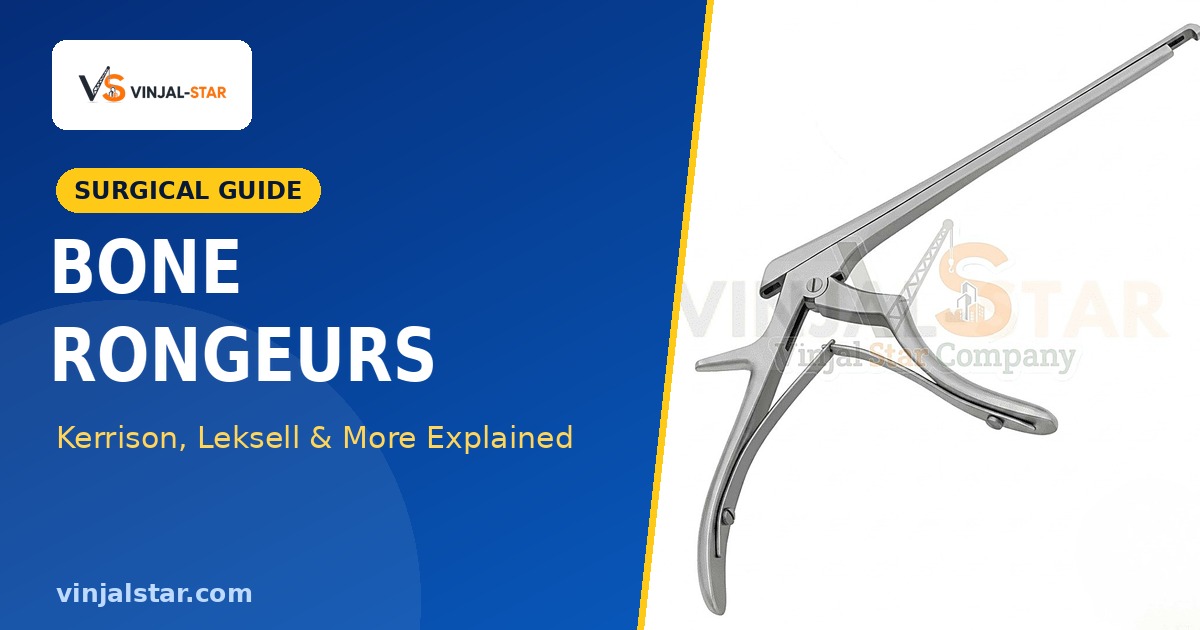
Quick answer: A bone rongeur is a heavy-duty, scoop-jawed instrument that bites small pieces of bone away, bit by bit, to open a window in bone or smooth a bone edge. Kerrison rongeurs work in narrow spinal and skull spaces with a thin shaft and an angled footplate, Leksell rongeurs are heavy double-action patterns for dense bone in orthopedic and neurosurgery, and single-action patterns give finer control on smaller bone. The bite size, the jaw angle and the action decide which pattern fits the procedure, and a dull or loose rongeur crushes bone instead of cutting it.
What Is a Bone Rongeur?
A rongeur, from a French word meaning gnawer, is a surgical instrument with a sharp-edged, scoop-shaped tip used for gouging out bone. Unlike a bone cutting forceps, which shears through a bone like a plier, a rongeur bites and scoops, removing a small, controlled piece with each closure. The surgeon repeats the bite around the edge of the opening until the window is the right size, which gives far more control than a single large cut and protects the soft tissue underneath.
Most rongeurs share the same build: two handles joined by a pivot or a double-action joint, a spring that holds the jaws open, and a cupped cutting jaw at the tip. The cutting edge is the working part, and it must stay sharp. A rongeur is used in neurosurgery, orthopedic surgery, spinal surgery, maxillofacial surgery, hand surgery and dental surgery, wherever a controlled opening in bone or a smoothed bone edge is needed. In hand surgery, for example, a rongeur trims traumatic amputated bone so skin can close over the defect, and in cadaver dissection it breaks through ribs to remove the anterior chest wall.
At Vinjal Star we manufacture bone rongeurs in Sialkot, Pakistan, in double-action and single-action builds. Our bone rongeur range covers straight and curved jaws in a 15 to 23 cm length range, with bite sizes from 2 to 6 mm, supplied for orthopedic and spinal distributors on OEM and private label terms.
How a Rongeur Works
The rongeur jaw is a small cup with a sharp rim. When the handles close, the rim shears through a thin layer of bone and the cup holds the fragment, which the surgeon then lifts away. Because each bite removes only a few millimetres, the surgeon can follow a curved line, work around a nerve or vessel, and stop at exactly the right depth. The scoop shape also lets the jaw slide under a bone edge and lift it, which matters in spinal work where the bone lies over the spinal cord and the dura beneath must not be touched.
Two mechanisms drive the jaw. A single-action rongeur has one pivot, like a plier, and gives direct tactile feedback: the hand feels the bone resist and give. A double-action rongeur has a compound joint that multiplies hand force, so dense bone can be bitten with less effort and less hand fatigue over a long case. Double-action patterns are heavier and more complex to clean, but they repay that cost wherever the bone is thick. The choice is therefore a trade between feel and force, not a ranking of quality.
The Main Types of Bone Rongeurs
Kerrison Rongeurs
The Kerrison rongeur is the narrow, elongated pattern used in spinal and neurosurgery. It has a thin shaft, a footplate that slides under the bone, and a cutting jaw that closes down onto the footplate at an angle, commonly 40 degrees, with up-biting, down-biting and straight versions. The footplate protects the tissue underneath while the jaw bites the bone above it, which is why the Kerrison is the standard tool for laminectomy, foraminotomy and other spinal decompression work, where bone must be removed millimetre by millimetre over the spinal canal. Kerrison rongeurs are named for Robert Masters Kerrison, an English physician whose early design took more than a century to reach its modern form.
Leksell Rongeurs
The Leksell rongeur is a heavy, double-action pattern built for dense bone. It has a strong, elongated build, straight or curved jaws, and a scoop tip that bites cleanly through thick cortical bone. Lars Leksell developed the double-action design, and it became indispensable in neurosurgery and orthopedic surgery, including during war-related laminectomies where speed and power mattered. Leksell rongeurs suit joint replacement preparation, spinal bone removal and any case where a single-action jaw would need excessive hand force. Bite sizes are commonly 3 to 8 mm, and the pattern is supplied in several lengths to reach deep fields.
Single-Action and Stille-Luer Rongeurs
Single-action rongeurs use one pivot and a lighter build, which makes them precise on thin or small bone and easier to clean and maintain. The Stille-Luer pattern is a well known single-action design with a straight or curved jaw, used in maxillofacial surgery, hand and foot surgery, and small bone removal. Where the bone is thin, such as the facial bones or the small bones of the hand, a single-action rongeur gives the control a double-action pattern would overpower.
Cushing and Other Slim Rongeurs
Cushing rongeurs are slim, elongated patterns with sharp jaws and angled options, built for neurosurgery, spinal surgery and ENT work in narrow spaces. Their light build and fine bite suit delicate bone around the skull base and the spine. Other named patterns in the same family include the Beyer rongeur, a curved heavy-duty pattern, the Friedman rongeur, a small pattern for fine bone work, and the Liston rongeur, a long-handled heavy pattern for large bone removal in orthopedic and spinal surgery. Catalogs also list bone nibblers, compact spring-handled patterns for contouring and shaping bone, which are rongeurs in function even when the name differs.
Pituitary and Intervertebral Disc Rongeurs
Pituitary and intervertebral disc (IVD) rongeurs are long, narrow patterns with a small cupped jaw at the end of a shaft, used to remove disc material and small bone fragments from deep, narrow spaces during spinal surgery. They are not general-purpose rongeurs: their shaft length and jaw size are matched to the disc space, and using them on dense cortical bone will damage the jaw. Buyers should treat them as a separate line item in a spinal set, not as a substitute for a Kerrison or Leksell pattern.
Comparison Table: Common Rongeur Patterns at a Glance
| Pattern | Action | Build | Main use |
|---|---|---|---|
| Kerrison | Sliding shaft, footplate | Thin, angled, 40 degrees common | Spinal decompression, laminectomy |
| Leksell | Double-action | Heavy, strong jaws | Dense bone, orthopedic, neurosurgery |
| Stille-Luer | Single-action | Light, fine jaws | Maxillofacial, hand and foot, small bone |
| Cushing | Single-action | Slim, elongated, angled | Neurosurgery, spine, ENT, narrow spaces |
| Beyer / Liston | Single or double | Heavy, curved or long-handled | Large bone removal, contouring |
| Pituitary / IVD | Sliding shaft | Long, narrow, small cup | Disc and deep spinal work |
Bite Size, Jaw Angle and Length: How to Specify a Rongeur
Three numbers define a rongeur order. The bite size, usually 2 to 8 mm, is the width of bone each closure removes: small bites for fine, controlled work near nerves, larger bites for fast removal of thick bone. The jaw angle decides the approach: straight jaws work on a flat surface, angled jaws reach around a corner or under an overhang, and up-biting and down-biting Kerrison jaws cut in opposite directions so the surgeon can work both sides of an opening without repositioning the patient. The length, commonly 15 to 23 cm, must reach the field with the handles clear of the wound edge; a rongeur that is too short forces the hand into the field, and one that is too long loses feel and control.
Buyers should also specify the jaw shape, straight or curved, the handle style, spring-loaded or box-lock, and whether the pattern must dismantle for cleaning. Kerrison rongeurs with a cleaning channel or a push-button opening mechanism are easier to reprocess, which matters in a busy sterile services department. Always confirm these details in writing before a bulk order, because two catalogs can list the same pattern name with different bite sizes.
How to Choose a Bone Rongeur for a Set or Facility
- Start from the specialty: spinal sets need Kerrison patterns in several angles plus a Leksell, orthopedic sets need Leksell and Stille-Luer patterns, and maxillofacial sets need single-action fine patterns.
- Match the action to the bone: double-action for dense cortical bone, single-action for thin bone and fine control.
- Order a range of bite sizes rather than one size, because a large bite near a nerve is a risk and a small bite on thick bone wastes time.
- Test a sample on bone or a bone model before accepting a batch: the jaw should bite cleanly, hold the fragment in the cup, and close without sideways play.
- Check cleaning: the jaw, the joint and any sliding shaft must come apart or open enough for brushes and ultrasonic cleaning, and the spring must return the jaw fully open after every closure.
Care, Sharpening and Sterilisation
Rinse a rongeur immediately after use, while bone debris is still soft, and brush the cup, the cutting rim, the joint and the spring before it dries. Bone chips left in the joint grind the pivot and dull the rim from the inside. Clean ultrasonically where the design allows, rinse with deionised water, dry fully, and autoclave with the jaw open so steam reaches the cutting faces. A rongeur that is stored closed will trap moisture at the rim and rust there first. Sharpening is a specialist job: the rim must be ground to the original angle without rounding the cup, and a rongeur that has been ground badly will crush bone instead of biting it. Build a sharpening or replacement cycle into the set plan, and retire any rongeur whose jaw wobbles sideways, whose spring no longer opens the jaw, or whose rim is chipped.
Frequently Asked Questions
What is a bone rongeur used for?
A bone rongeur bites small pieces of bone away to open a window in bone, smooth a bone edge, or remove bone fragments. It is used in neurosurgery, orthopedic, spinal, maxillofacial, hand and dental surgery.
What is the difference between a Kerrison and a Leksell rongeur?
A Kerrison rongeur is a thin, sliding-shaft pattern with a footplate that protects tissue underneath, used mainly in spinal surgery. A Leksell rongeur is a heavy double-action pattern for dense bone in orthopedic and neurosurgery.
What is the difference between single-action and double-action rongeurs?
A single-action rongeur has one pivot and gives more tactile feedback for fine work on thin bone. A double-action rongeur uses a compound joint to multiply force, so dense bone can be bitten with less hand effort.
What bite size should I order?
Small bites, 2 to 3 mm, suit fine work near nerves and vessels. Medium bites, 4 to 5 mm, cover most general orthopedic work. Large bites, 6 to 8 mm, suit fast removal of thick bone where precision is less critical.
Can bone rongeurs be resharpened?
Yes, by a specialist instrument sharpener who preserves the original rim angle and cup shape. Once the rim is chipped, the jaw is loose, or the spring has failed, replacement is safer than repair.
Buy Bone Rongeurs Wholesale
Vinjal Star Manufacturing has produced surgical instruments in Sialkot, Pakistan since 2013, working to CE MDD 93/42/EEC, Class I requirements and ISO 9001:2008 quality systems. Browse our bone rongeur range for double-action and single-action patterns in straight and curved jaws, or message us on WhatsApp at +92 346 3594812 for the full orthopedic catalog and wholesale pricing for hospitals, clinics and distributors.
Sources: Rongeur, Wikipedia.
One thought on “Bone Rongeurs: Types, Uses and Buying Guide”