

Blog
Surgical Instruments 101: The 7 Families Every Buyer Should Know

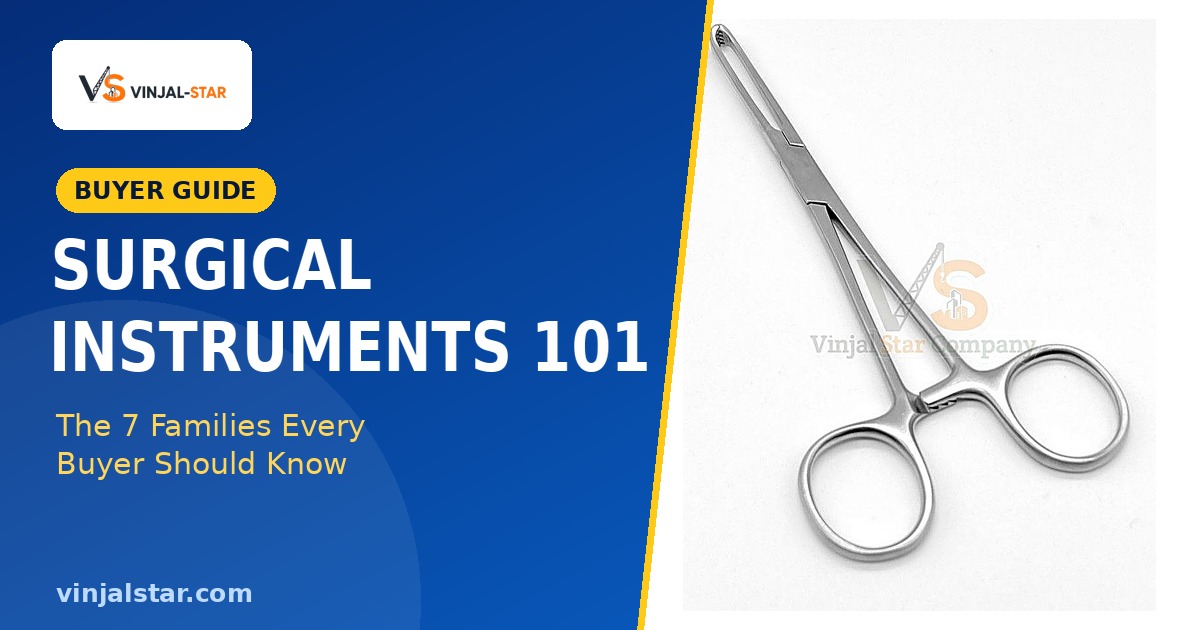
Quick answer: Surgical instruments fall into seven main families by the job they do: cutting, grasping, clamping, retracting, suturing, probing and suction. Cutting instruments divide tissue or suture. Grasping instruments hold tissue. Clamping instruments stay locked on a vessel or structure. Retracting instruments hold tissue aside. Suturing instruments hold the needle. Probing instruments explore or measure. Suction instruments clear fluid. This guide is for distributors, importers and clinic buyers, and it explains each family, what to specify when you order, and how to check quality on arrival.
In this guide: the seven families at a glance, cutting, grasping and clamping, retracting, suturing, probing and suction, materials and quality, care basics, and what to ask your supplier.
The 7 Families at a Glance
Buyers use the family name first and the pattern name second. The pattern name, such as Mayo, Kelly or Allis, tells you the exact shape, jaw and size. Always order by pattern, size and jaw detail, not by family name alone. A set is a group of instruments chosen together for one type of work.
FamilyTypical instrumentsWhat it doesFirst specification to checkCuttingScalpel handle and blades, Mayo and Metzenbaum scissors, bone rongeurDivides tissue, suture or boneBlade or edge type, straight or curved, lengthGraspingThumb forceps, tissue forceps, Allis and Babcock forcepsHolds and lifts tissueJaw: teeth, serrations or smooth, and jaw widthClampingKelly, Crile, mosquito and Kocher forcepsStays locked on a vessel or structureRatchet action, serration length, straight or curvedRetractingHand held retractors, Balfour and Weitlaner retractorsHolds tissue aside for a clear viewBlade size and shape, hand held or self retainingSuturingNeedle holders, Mayo-Hegar and Olsen-Hegar patternsHolds the suture needle firmlyJaw insert, jaw width, needle size rangeProbingProbes, directors, curettes, dilatorsExplores, measures or opens a passageTip shape, diameter, length, markingsSuctionYankauer, Poole and Frazier suction tubes and tipsClears fluid and debris from the fieldTip shape, bore size, length, handle control
Cutting Instruments: What to Specify
Cutting instruments divide tissue, suture material or bone with a blade or a sharp edge. The main types are scalpel handles with replaceable blades, scissors, and bone cutting instruments such as rongeurs.
Scalpel handles hold a disposable blade, and the handle number decides which blades fit. The most common pairing in general surgery is a No. 3 handle with No. 10, 11 and 15 blades, and a No. 4 handle with larger blades. Confirm the handle and blade numbers in the same order, and check that the blade locks firmly without sideways play.
Scissors are specified by pattern, length, blade shape and edge. Mayo scissors are heavy, with short blades and long handles, and suit thick tissue and suture. Metzenbaum scissors are lighter, with long handles and long, slender blades, and suit delicate tissue. Straight blades cut on a flat surface. Curved blades follow a curve and keep the tips in view. SuperCut and tungsten carbide edges stay sharp longer than plain steel, but they cost more and need specialist sharpening.
Bone cutting instruments need three numbers: bite size or jaw width, jaw angle, and length. A small bite gives fine control near nerves and vessels. A larger bite removes thick bone faster. Angled jaws reach around a corner or under an overhang. Test a sample edge before accepting a batch. An edge that crushes instead of cutting will damage tissue and bone. Our bone rongeurs guide explains bite size, jaw angle and length in full.
Grasping and Clamping: Jaw, Teeth, Ratchet, and Tissue Match
Grasping and clamping instruments look alike, but they do different jobs. Grasping instruments hold tissue while it is cut or sutured, and the hand controls them throughout. Clamping instruments lock shut with a ratchet and stay in place without continuous hand pressure.
The jaw decides the grip. Toothed jaws interlock and hold firmly, but they mark tissue, so they belong on skin, fascia and tissue that will be removed. Smooth jaws grip least and injure least, which suits delicate vessels and dressings. Serrated jaws grip without a single piercing point. Fenestrated jaws have a window in each blade, which spreads pressure for a secure, less crushing hold. A good example is our Allis tissue forceps, 6 inch with 5×6 interlocking teeth, which grips fascia and skin edges with pressure spread across the tooth line.
Clamping instruments add a ratchet, a row of interlocking teeth on the shanks near the finger rings. Closing the rings one click at a time increases jaw pressure in steps, and the ratchet holds the chosen pressure until it is released. Kelly forceps are serrated on only part of the jaw, for general clamping with a lighter hold. Crile forceps are serrated along the full jaw, for a firmer hold. Mosquito forceps are small and fine, for small vessels. Kocher forceps are heavy, with teeth at the tips, for large vessels and heavy tissue. Check the ratchet on every new delivery: it should engage cleanly at the first click, hold under a firm pull without slipping, and release smoothly. Our surgical forceps guide compares the main groups, with checks for teeth, serrations and jaw alignment.
Length matters as much as the jaw. Short patterns, around 12 to 15 cm, suit surface and fine work. Standard 18 cm patterns cover most general surgery. Longer patterns reach deep fields. Order the lengths your procedure list actually needs, in straight and curved forms where the work calls for them.
Retracting, Suturing, Probing and Suction: The Other Four Families
Retracting instruments hold tissue aside so the working area stays visible. Hand held retractors need an assistant, and come in many blade shapes. Self retaining retractors lock open on their own, so both hands stay free. The Balfour retractor is a self retaining abdominal pattern with fenestrated side blades and a solid centre blade on a frame, supplied in several spread sizes. Our Balfour abdominal retractor set, 4, 7 and 10 inch spread, covers small, standard and deep cavity work in one set. Specify blade width and depth, the spread size, and whether the pattern is hand held or self retaining.
Suturing instruments hold the suture needle. The needle holder is the main instrument in this family. It has short, strong jaws, a locking ratchet, and often a tungsten carbide insert. Mayo-Hegar needle holders suit general suturing. Olsen-Hegar patterns add a scissor blade for cutting suture. Our Mayo-Hegar needle holder with gold handle is the standard general pattern, and the gold handle marks the tungsten carbide jaw insert. Specify jaw width, jaw length, whether the insert is tungsten carbide, and the needle size range. The jaws should meet evenly and hold a needle firmly without rotation. Our needle holders guide compares the main patterns.
Probing instruments explore, measure or open a passage. Probes are slim, blunt instruments used to check the depth or direction of a wound or cavity. Directors guide a blade or another instrument along a channel. Curettes scoop or scrape tissue, in sharp and blunt forms with many cup sizes. Dilators open a narrow passage step by step, in a graded set of sizes. Specify tip shape, diameter or cup size, length, and any markings.
Suction instruments clear fluid, blood and debris so the field stays visible. The Yankauer suction tube has an angled tip with side holes and a handle control, and suits general suction. The Poole suction tube has an outer guard with many holes, and suits abdominal work where tissue must not block the tip. The Frazier suction tip is fine and angled, and suits narrow fields. Specify tip shape, bore size, length, and whether the handle has a control hole or valve.
Materials and Quality: Steel Grade, Finish, Tungsten Carbide, Marking
Most reusable instruments are made from stainless steel, but grades differ. The grade decides hardness, edge holding, spring at the joint, and resistance to staining. Vinjal Star instruments use German or Japanese steel grades in the AISI 410, 420 or 440 series for instruments that need a lasting edge and a firm joint. Ask your supplier which grade is used for each pattern, and why that grade was chosen for that job.
Finish is the surface treatment of the instrument. A satin finish is dull and reduces glare under theatre lights. A mirror finish is bright and smooth, and shows marks more easily. Passivation is a chemical treatment after polishing that strengthens the thin protective layer on stainless steel. Ask whether the instrument is passivated after polishing, and what finish is supplied as standard. Check the finish on arrival under good light: it should be even, with no rough patches or pits.
Tungsten carbide inserts are small, hard plates fitted to the jaws of needle holders, scissors and some forceps. They grip or cut with less wear than plain steel, and are often marked by gold coloured handles. Titanium instruments are much lighter than steel, but cost more. Tungsten carbide pays back where the jaw must grip a needle many times without slipping.
Marking and traceability close the quality loop. Each instrument should carry a clear maker mark, a pattern or catalogue number, and, where agreed, the buyer brand or logo. Marking should be legible after cleaning and must not sit on a working edge or a jaw face. Ask how marking is applied and what traceability the supplier keeps for a batch. Keep a simple record on arrival: pattern, size, quantity, date, and any fault found.
Care Basics That Protect the Buy
Care starts soon after use. Rinse or clean instruments while blood and tissue are still soft, with jaws and joints open, so debris does not dry into serrations, teeth and ratchets. Clean with a neutral pH cleaner made for surgical instruments, rinse fully, and dry fully, including joints and serrations, before storage. Store instruments dry, with tips and jaws not touching other instruments. Inspect on a regular cycle: joint action, jaw alignment, ratchet hold, edge and marking. Follow the instructions for use and your facility protocol.
What to Ask Your Supplier
- Which steel grade is used, and why is it chosen for this job?
- What finish is supplied, and is the instrument passivated after polishing?
- Is a tungsten carbide version available, and when is the upgrade worth the cost?
- What marking comes with each instrument, and can a mill test certificate be provided on request?
- What is the minimum order, and can a sample be ordered before a bulk order?
- What should the receiving check cover: finish, joint, jaw alignment, ratchet, edge and marking?
- What care instructions come with the instrument, and what cleaners must not be used?
Frequently Asked Questions
Which family should a new buyer stock first?
Start from the procedure list, not from a catalogue. Most general sets need cutting, grasping, clamping and suturing patterns first, then retracting patterns matched to the depth of work. A sample of each main pattern, tested in hand, beats a large order of one family.
What is the difference between toothed and smooth forceps?
Toothed forceps interlock and hold firmly, but they mark tissue, so they suit skin, fascia and tissue that will be removed. Smooth forceps grip least and injure least, so they suit delicate vessels, dressings and fine tissue.
When is tungsten carbide worth paying for?
Tungsten carbide pays back on needle holders and scissors that are used heavily, where the jaw must grip without slipping or the edge must stay sharp through many uses. For light or occasional use, a well made plain steel pattern is often enough.
How does a buyer check quality on arrival?
Check finish under good light, joint action, jaw alignment, ratchet hold, edge condition and marking, on a sample from each pattern. Jaws should meet evenly with no gap and no sideways wobble. The ratchet should engage at the first click and hold under a firm pull.
What does a set mean, compared with single instruments?
A set is a group of instruments chosen together for one type of work, often in a tray. Single instruments are ordered one pattern at a time. Sets suit a new service that needs a complete tray at once.
How do I ask for a quotation?
Send the item codes or pattern names, sizes, quantities and destination country. Item codes remove doubt when two catalogues use the same pattern name for different sizes. Ask for the quotation to state grade, finish, marking, minimum order and sample terms.
Request a Quotation or Catalogue
Vinjal Star Manufacturing has produced surgical instruments in Sialkot, Pakistan since 2013, working to CE MDD 93/42/EEC, Class I requirements and ISO 9001:2008 quality systems. Send us your item codes for a price quotation, or message us on WhatsApp at +92 346 3594812 for the full catalogue and wholesale pricing for hospitals, clinics and distributors. The minimum order is USD 200, and single pieces can be ordered.
By Vinjal Star Manufacturing, Sialkot. Reviewed by the Vinjal Star Quality Team. Published: 2 November 2026. Updated: 2 November 2026.
Follow the instrument instructions for use and your facility protocol. It is not surgical or clinical advice.
Sources: Surgical instrument, Wikipedia; ISO 7153-1:2016, Surgical instruments, Materials.
2 thoughts on “Surgical Instruments 101: The 7 Families Every Buyer Should Know”