

Blog
Surgical Stainless Steel Grades Explained: 410, 420 and 440, What Each Grade Is For

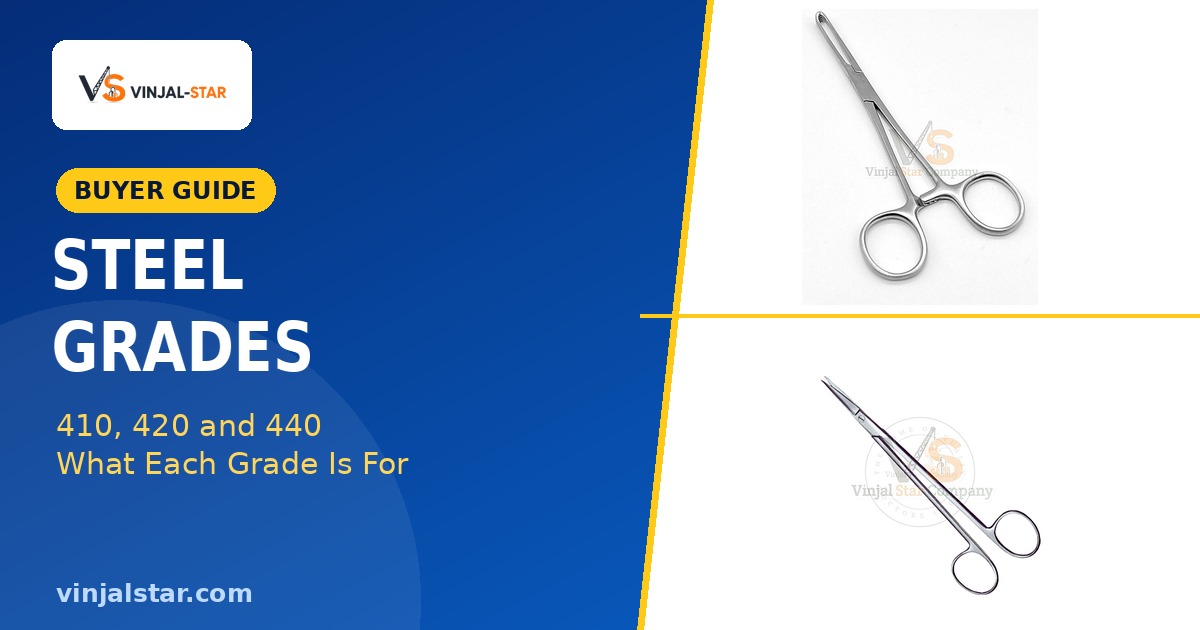
Quick answer: Vinjal Star instruments use German or Japanese steel grades in the AISI 410, 420 or 440 series for instruments that need a lasting edge and a firm joint. In general, 410 is the toughest and least hard, 420 is the balanced middle grade for most cutting and hinged instruments, and 440 is the hardest and holds an edge longest. No single grade is best for every instrument: the right grade depends on whether it must cut, grip, spring back at a joint, or survive repeated use without chipping.
In this guide: grade numbers, 410, 420 and 440, comparison, choosing, care checks, and supplier questions.
What a Steel Grade Number Means
A grade number is a recipe, not a quality stamp. The AISI number groups steels by alloy content. For these three grades, carbon and chromium matter most. Chromium, at about 12 percent or more, forms the thin protective layer that resists staining. Carbon controls hardness: more carbon, after correct heat treatment, gives a harder edge that stays sharp longer, but also makes steel less tough, so it can chip more easily if misused.
Heat treatment matters as much as the recipe. The three grades in this guide are martensitic stainless steels, which can be hardened by heating and cooling in a controlled way. A well chosen grade with poor heat treatment will still fail early. Finish and passivation matter too: passivation is a chemical treatment after polishing that strengthens the protective layer. Ask about grade, heat treatment, finish and passivation together, not grade alone. Our Surgical Instruments 101 guide explains how cutting, grasping and clamping instruments place different demands on steel.
410: Toughness First
In general industry use, 410 has the lowest carbon of the three, about 0.15 percent at most, with chromium around 11.5 to 13.5 percent. That gives good toughness and resistance to cracking, but only moderate hardness after heat treatment, so it will not hold the finest edge as long as the higher carbon grades.
That trade off suits parts where spring, strength and toughness matter more than a razor edge: instrument bodies, handles and clamping parts that are opened, closed and flexed many times. A tough grade is less likely to chip when knocked, so for a joint that must bend and spring back, 410 is the natural starting point.
420: The Balanced Middle Grade
In general industry use, 420 sits in the middle, with carbon around 0.15 to 0.40 percent and chromium around 12 to 14 percent. After heat treatment it is harder than 410, so it holds a better edge, while keeping more toughness than the hardest grade. That balance is why 420 is the most widely used of the three for general surgical instruments.
It suits scissors, forceps, needle holders and other hinged instruments where an edge or jaw must work well and a joint must stay firm. Our Metzenbaum dissecting scissors, 5.75 inch curved, show why: the blades must cut cleanly, and the joint must stay smooth through repeated use. Our Mayo-Hegar needle holder shows the same balance: its jaws must grip a needle firmly, and the ratchet must hold under pressure.
440: Hardest Edge, Longest Edge Life
In general industry use, 440 has the highest carbon of the three. The best known form has carbon around 0.95 to 1.20 percent and chromium around 16 to 18 percent. After correct heat treatment, that gives the hardest edge of the three and the longest edge life.
The trade off is brittleness. A very hard edge can chip if used on material it was not made for, dropped, or forced, and it needs careful heat treatment and qualified sharpening. Choose 440 where edge life is the main cost driver, for heavily used cutting instruments. Do not choose it simply because it sounds strongest: for a general purpose instrument knocked about daily, a tougher or more balanced grade may last longer.
The Three Grades Side by Side
| Grade | Carbon, in general | Hardness and edge life | Toughness | Best suited, in general, for |
|---|---|---|---|---|
| 410 | Lowest of the three | Moderate, shortest edge | Highest | Bodies, handles, toughness first |
| 420 | Middle | Good, balanced | Good, balanced | Most scissors, forceps, needle holders |
| 440 | Highest | Highest, longest | Lowest, chip risk | Heavy use cutting edges |
Read the table as a general guide only, not as a Vinjal Star specification for one pattern. Always confirm the grade for the exact item you order, since it depends on pattern, size and job. Corrosion resistance also falls slightly as carbon rises across these three grades. Our surgical forceps guide shows how jaw, teeth and joint checks sit alongside the grade question on arrival.
How to Choose and Specify the Grade
Start from the job, not from the number. Cutting edges need hardness and edge life, gripping jaws and joints need firmness and toughness, and hinged instruments need both, which points to the balanced middle grade unless the use is extreme. If chipping is the main risk, favour toughness; if dulling is the main risk, favour edge life. A hard edge needs qualified sharpening, so without a qualified service, an easier grade to maintain may cost less over its life.
Compare like with like: the same pattern in the same grade can still differ in finish and joint work. Check a sample in hand: the joint should move smoothly, the jaws should meet evenly, and a scissor edge should cut cleanly. Our needle holders guide lists jaw and ratchet checks for most hinged instruments. Ask for the grade for each pattern and size, not one grade for a catalogue.
Grade Related Care Checks
Grade does not remove the need for care. A hard edge still chips if forced, and a tough grade still suffers if debris dries into joints and serrations. Clean soon after use, with jaws and joints open, using a neutral pH cleaner made for surgical instruments. Rinse and dry fully, including joints and serrations, before storage, with tips and jaws not touching other instruments.
On inspection, check the edge, joint and jaw together. A dull edge may need qualified sharpening; a loose joint or misaligned jaw needs repair review. With our Allis tissue forceps, 6 inch with 5×6 interlocking teeth, check that the tooth line meets evenly and the ratchet holds.
What to Ask Your Supplier
- Which grade is used for this exact pattern and size, and why was it chosen for this job?
- What heat treatment and finish are supplied as standard?
- Is the instrument passivated after polishing, and can a mill test certificate be provided on request?
- What sharpening or repair service is recommended?
- What should the receiving check cover: edge, joint, jaw, ratchet, finish, marking?
Frequently Asked Questions
Which grade should a new buyer choose first?
Start with the balanced middle grade, 420, for most cutting and hinged instruments, unless the job calls for the toughest or the hardest edge. Confirm the grade for each pattern before you order, and check a sample in hand where possible.
Is the hardest grade always the best?
No. The hardest grade holds an edge longest, but it is the least tough and can chip if misused. For a general purpose instrument, the balanced middle grade often lasts longer in daily use.
Does a higher grade number mean better quality?
No. The number describes the recipe, not finished quality. Heat treatment, finish, joint work and inspection matter as much as the number.
Can one grade cover a whole set?
Sometimes. A set may mix grades: a tougher grade where parts flex or take load, and a harder grade where an edge must stay sharp. Ask for the grade for each pattern, not one grade for a whole catalogue.
How do I ask for a quotation by grade?
Send item codes or pattern names, sizes, quantities and destination country, and ask the quotation to state the grade, finish and inspection checks for each item.
Request a Quotation or Catalogue
Vinjal Star Manufacturing has produced surgical instruments in Sialkot, Pakistan since 2013, working to CE MDD 93/42/EEC, Class I requirements and ISO 9001:2008 quality systems. Send us your item codes for a price quotation, or message us on WhatsApp at +92 346 3594812 for the full catalogue and wholesale pricing. Minimum order: USD 200.
By Vinjal Star Manufacturing, Sialkot. Reviewed by the Vinjal Star Quality Team. Published: 5 November 2026. Updated: 5 November 2026.
Follow the instrument instructions for use and your facility protocol. This guide explains instrument materials from the manufacturer side. It is not surgical or clinical advice.
Sources: Stainless steel, Wikipedia; ISO 7153-1:2016, Surgical instruments, Materials.