

Blog
Scalpel Blades: Sizes, Types and Handle Fitting Guide

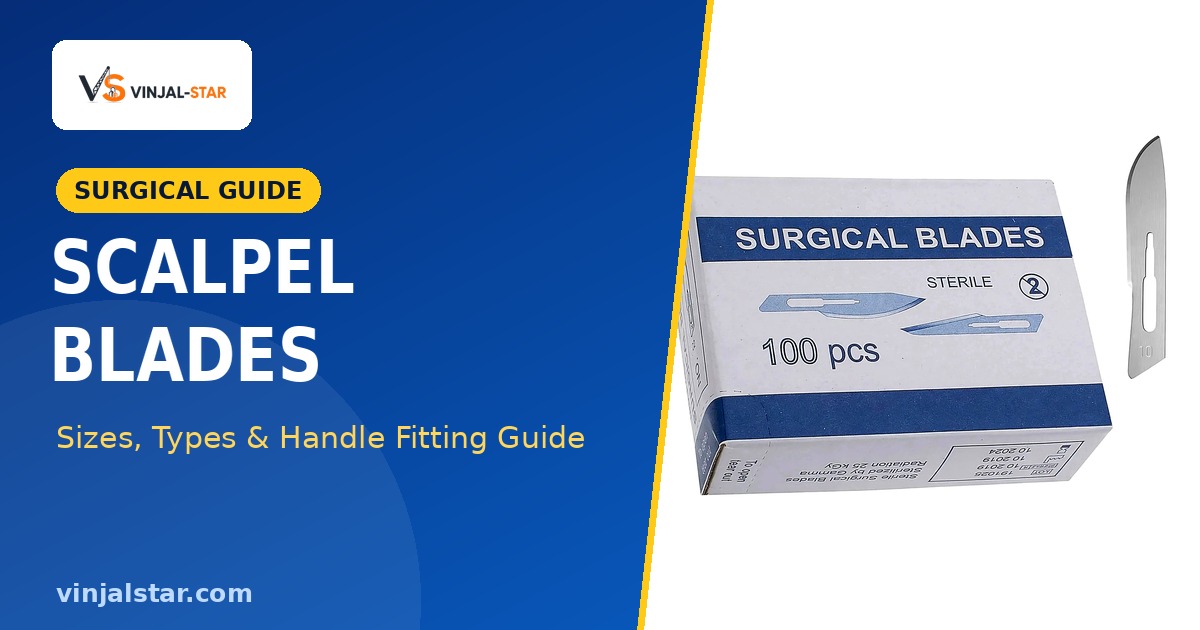
Quick answer: Scalpel blades are numbered by shape and size. Small blades (No. 10, 11, 12 and 15) fit a No. 3 handle, while large blades (No. 20 to 24) fit a No. 4 handle. Choosing the right number for the incision is what gives a surgeon a clean, controlled cut with minimal tissue damage.
What Is a Scalpel Blade?
A scalpel blade is a sterile, single-use cutting edge that locks onto a reusable surgical handle. Together they form the scalpel, the primary incision instrument in almost every surgical specialty. Blades are made from stainless steel or carbon steel, ground to a fine edge and supplied sterile in individual foil packs.
At Vinjal Star we supply sterile scalpel blades for the No. 3 handle in boxes of 100 pieces, ready for hospitals, clinics and distributors.
Common Blade Sizes and Their Uses
- No. 10: The most widely used blade. Its curved cutting edge suits skin incisions in general, abdominal and orthopedic surgery.
- No. 11: A pointed, triangular blade for stab incisions, abscess drainage and opening vessels or airways.
- No. 12: A hooked blade used in ENT and dental work, and for cutting sutures and tissue in confined spaces.
- No. 15: A small version of the No. 10 profile. Ideal for precise, delicate incisions in plastic, pediatric and facial surgery.
- No. 20 to 24: Larger blades for the No. 4 handle, used for bigger incisions in general and orthopedic procedures.
Handle Fitting: No. 3 vs No. 4
Blade fitting follows a simple rule. The small fitting (blades 10 to 15) matches the No. 3 and No. 7 handles. The large fitting (blades 20 to 24) matches the No. 4 handle. A blade must click firmly into the handle groove; a loose blade is a safety risk and should be replaced at once.
Always fit and remove blades with a needle holder or a blade remover, never with fingers. Used blades go straight into a sharps container.
Stainless Steel vs Carbon Steel
Carbon steel blades are traditionally very sharp and cost-effective, but they corrode faster. Stainless steel blades resist corrosion, stay consistent in sterile storage and are preferred where packs may be stored for long periods. For most distributors and hospitals, stainless steel offers the better balance of edge quality and shelf life.
How to Choose Scalpel Blades for Your Facility
- Match the blade numbers to the procedures your surgeons perform most.
- Confirm the handle fitting (No. 3 or No. 4) before ordering in bulk.
- Check sterile packing, expiry dating and box quantity for your stock rotation.
- Buy from a manufacturer with documented quality control, so every blade in the box cuts the same way.
Frequently Asked Questions
Which blades fit a No. 3 handle?
Blades No. 10, 11, 12 and 15 fit the No. 3 handle. Larger blades from No. 20 upwards need a No. 4 handle.
Are scalpel blades reusable?
No. Surgical blades are sterile, single-use items. Reusing a blade risks infection and a dull edge that tears tissue instead of cutting it.
What is the difference between a No. 10 and a No. 15 blade?
Both share a similar curved profile, but the No. 15 is much smaller, giving finer control for delicate work.
How should blades be stored?
In their sealed foil packs, in a dry place, until the moment of use. Damaged packs should be discarded.
Order Scalpel Blades Wholesale
Vinjal Star Manufacturing has produced surgical instruments in Sialkot, Pakistan since 2013, under an ISO 13485:2016 quality system. See our sterile scalpel blades for No. 3 handles, or message us on WhatsApp at +92 346 3594812 for wholesale pricing and OEM supply.
Sources: Scalpel, Wikipedia