

Blog
Orthopedic Instruments Manufacturers: How to Choose a Supplier

Quick answer: The right orthopedic instruments manufacturer is the one whose quality system, material traceability, sample quality and delivery record you can verify, not the one with the lowest unit price. Check ISO 13485 certification, CE marking for Europe and FDA registration for the United States, ask for the stainless steel grade and hardness, test samples for jaw alignment, edge retention and joint play, and confirm minimum order quantities, lead times and OEM terms in writing before any bulk order. A manufacturer in Sialkot, Pakistan, the historic home of hand-finished surgical instruments, can match or beat factory quality elsewhere, but only the checks in this guide separate a reliable maker from a trading middleman.
What Orthopedic Instruments Manufacturers Make
Orthopedic instruments are the hand tools of bone and joint surgery: instruments that cut, hold, reduce, fix and measure bone. The range is wider than general surgery, because bone is harder, the forces are larger, and the procedures are more specialized. A general orthopedic set includes bone holding forceps, bone cutting forceps, rongeurs, osteotomes, chisels and gouges, mallets, curettes, elevators, retractors, wire passers, depth gauges, K-wires and pins, reamers, and saws. Trauma sets add reduction forceps and plate holding forceps. Joint replacement sets add rasps, broaches and trial instruments matched to an implant system. Spinal sets add Kerrison rongeurs, disc rongeurs and distractors. No single set covers every procedure, and a manufacturer that claims one set does everything is a warning sign, not a selling point.
Orthopedic instruments carry higher loads than soft tissue instruments, and their inspection reflects that. A bone rongeur must bite cleanly through cortical bone without the jaw flexing. A bone holding forceps must hold a cylindrical bone without slipping while a plate is fixed. An osteotome must hold an edge through repeated mallet blows. These demands are why material, heat treatment and finishing matter more in orthopedics than in any other hand instrument family, and why a buyer should never choose on price alone.
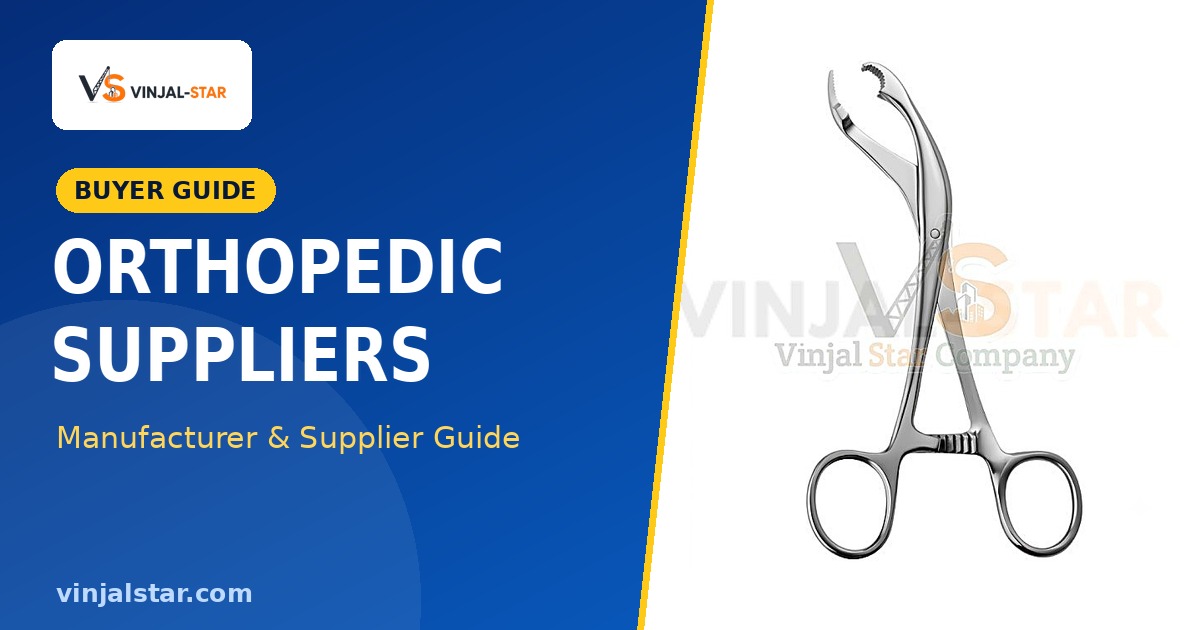
At Vinjal Star we manufacture orthopedic instruments in Sialkot, Pakistan, including bone holding forceps, rongeurs, osteotomes, wire instruments and depth gauges. A representative pattern is our Verbrugge bone holding forceps, a self-centering pattern with curved, serrated jaws and a ratchet lock, built to grip the femur, tibia and humerus during fracture reduction and plate fixation.
Manufacturer, Supplier and Distributor: Three Different Roles
The words manufacturer, supplier and distributor are often used as if they meant the same thing, and in orthopedic sourcing they do not. A manufacturer forges, machines, finishes and inspects the instrument in its own facility. A supplier may manufacture, or may buy from several makers and sell under its own name. A distributor buys finished stock and resells it, usually with local warehousing and service, but with no control over how the instrument was made. Each role has a place: a manufacturer gives the best control over specification and price, a supplier gives breadth of range, and a distributor gives speed and local support. The mistake is paying a manufacturer price to a distributor, or expecting a distributor to change a specification it did not make.
Ask the direct question, and ask for evidence: does the company forge and finish in house, or does it outsource? A real manufacturer can show a factory, a production flow, in-house inspection records and material certificates. A trading company will talk about range and price and avoid the factory question. Both can be legitimate partners, but the buyer should know which one is being paid, and should price and contract accordingly.
Certifications and Compliance: What to Verify
ISO 13485 and ISO 9001
ISO 13485 is the quality management standard for medical devices, and it is the baseline certification a serious orthopedic manufacturer should hold. It covers design control, production control, traceability, corrective action and post-market surveillance in a way that ISO 9001 alone, the general quality management standard, does not. Ask for the certificate, check the scope covers surgical instruments, check the expiry date, and check the certification body. A certificate that has expired, or whose scope covers only trading, does not prove manufacturing quality.
CE Marking and MDR
For Europe, reusable surgical instruments must carry CE marking under the Medical Device Regulation, EU 2017/745, with a technical file, a declaration of conformity and a Unique Device Identification system. Ask which device class the instruments fall under, who the authorized representative in Europe is, and whether the technical documentation can be reviewed under a confidentiality agreement. A manufacturer that cannot answer these questions is not ready for the European market, whatever its catalog claims.
FDA Registration and Other Markets
For the United States, the manufacturer or its importer must be registered with the FDA, and the device must be listed, with 510(k) clearance where the device class requires it. Most Class I reusable hand instruments are exempt from premarket notification but are still subject to registration, listing and quality system rules. For the Gulf, the United Kingdom, Australia and other markets, ask for the specific local requirement before ordering, because a CE mark alone does not open every market. Keep the regulatory conversation in writing, and keep the documents with the purchase order.
Materials, Hardness and Finishing: The Technical Checks
Ask for the stainless steel grade in writing. Reusable orthopedic instruments are commonly made from martensitic grades such as AISI 410 and 420 for cutting and gripping instruments, which harden well and hold an edge, and austenitic grades such as 316L for instruments that need corrosion resistance more than hardness. German-origin steel is often specified for premium ranges. Ask for mill certificates or material test reports on the first order, and for batch traceability on every order after that, so a failure can be traced to a material batch rather than blamed on use.
Ask for hardness, expressed in HRC, for cutting instruments. A rongeur or osteotome that is too soft will dull on the first case, and one that is too hard will chip. Ask how the instrument is passivated, the chemical treatment that builds the corrosion-resistant surface layer, and confirm autoclave compatibility with the cycles the hospital actually uses. On samples, check the finish under magnification: grinding marks should run in one direction, edges should be even, joints should have no lateral play, and the instrument should sit flat and balanced in the hand. These checks take minutes and reveal more than any brochure.
How to Evaluate a Manufacturer: A Seven-Step Process
- Define the requirement first: procedure types, pattern list, quantities, target markets and regulatory needs, so every manufacturer is quoted on the same specification.
- Shortlist on evidence, not on search ranking: certification scope, factory evidence, export history in your market, and references from buyers in similar markets.
- Request samples of the hardest-working patterns, not the easiest: a rongeur, a bone holding forceps and an osteotome will reveal quality faster than a retractor.
- Test the samples in the operating theatre or on bone models, with the surgeons who will use them, and record edge retention, jaw alignment, ratchet hold and joint play after several reprocessing cycles.
- Confirm commercial terms in writing: minimum order quantity, unit price by quantity tier, lead time, payment terms, packaging, marking and labelling, and who pays for freight, insurance and customs.
- Agree quality terms in writing: acceptance inspection, defect rate, replacement or refund for defective pieces, and a corrective action process for repeat failures.
- Start with a trial order, then scale: a manufacturer that performs on a small order and communicates clearly during it is the one to trust with a container.
Minimum Orders, Lead Times and Pricing
Minimum order quantities for orthopedic instruments commonly range from 25 to 500 pieces per pattern, depending on the maker and the complexity of the instrument. Lower minimums usually mean higher unit prices, and higher minimums mean better prices but more stock risk. Ask whether the minimum is per pattern, per set or per order, because the answer changes the real cost of a mixed order. Lead times for standard catalog patterns are commonly two to six weeks, and OEM or custom patterns take longer, because marking, packaging and any tooling must be agreed and sampled first. Treat any promise of immediate delivery of a large custom order with caution, and build a buffer into the first order with any new maker.
Price orthopedic instruments on total cost, not unit price alone. Freight, customs, inspection, reprocessing, sharpening, replacement of defective pieces and the cost of a failed case all belong in the comparison. A cheap rongeur that dulls in one case and must be replaced costs more than a well made one that lasts for years, and a cheap bone holding forceps that slips during plating costs far more than money. Ask for a landed cost quotation, and compare like with like on steel grade, hardness, finish and warranty.
Custom, OEM and Private Label Manufacturing
Many orthopedic buyers order under their own brand. OEM manufacturing means the maker produces to the buyer’s specification, drawings or sample, and marks the instrument with the buyer’s logo, catalogue code and packaging. The buyer owns the brand and the market, the maker owns the production. Agree the specification, the marking artwork, the packaging, the regulatory responsibility and the confidentiality terms before production, and approve a pre-production sample in writing. A good OEM maker will also advise where a requested change would weaken the instrument or break a standard, and a buyer should listen, because a logo on a weak instrument damages the brand it was meant to build. Our separate OEM and private label guide covers this process in full.
Red Flags in Orthopedic Sourcing
- No verifiable factory, no certification scope covering manufacturing, or a certificate that cannot be checked with the certification body.
- A catalog that copies another maker’s photos, pattern names and descriptions without any original product evidence.
- Refusal to supply samples, material certificates or a pre-production sample for an OEM order.
- Unit prices far below every other quotation, with no explanation of steel grade, hardness or inspection.
- Vague lead times, no written acceptance terms, or pressure to pay in full before any sample is seen.
- Claims of FDA approval or CE certification for the whole catalog, when the documents cover only part of the range.
Why Sialkot Matters for Orthopedic Instruments
Sialkot, in Pakistan, has made hand-finished surgical instruments for well over a century, and it remains the largest cluster of surgical instrument makers in the world. The cluster gives buyers a deep bench of forging, grinding, polishing and inspection skill, a supply chain for surgical steel and components, and makers who understand export documentation, marking and packaging for Europe, North America and the Gulf. That depth is an advantage, but it also means the range of quality is wide, from world-class makers to small workshops with no quality system at all. The checks in this guide are how a buyer finds the first group and avoids the second. Vinjal Star Manufacturing has worked in Sialkot since 2013, and its orthopedic range is built under the same quality systems as its general surgical range.
Frequently Asked Questions
What certifications should an orthopedic instruments manufacturer have?
ISO 13485 for medical device quality management is the baseline, plus CE marking under EU MDR 2017/745 for Europe and FDA registration and listing for the United States. Check the certificate scope, expiry and certification body, not just the claim.
What is the minimum order for orthopedic instruments?
It varies by maker and pattern, commonly 25 to 500 pieces per pattern. Confirm whether the minimum is per pattern, per set or per order, and ask for price tiers by quantity.
How long does an orthopedic order take?
Standard catalog patterns commonly take two to six weeks. OEM and custom patterns take longer, because specification, marking, packaging and sampling must be agreed first.
Should I buy from a manufacturer or a distributor?
Buy from a manufacturer for specification control, OEM work and the best factory price. Buy from a distributor for speed, local stock and local service. Know which role your supplier plays, and price accordingly.
Can I get samples before a bulk order?
Yes, and you should insist on it. Test the hardest-working patterns, such as a rongeur and a bone holding forceps, through several reprocessing cycles before committing to a bulk order.
Source Orthopedic Instruments Wholesale
Vinjal Star Manufacturing has produced surgical instruments in Sialkot, Pakistan since 2013, working to CE MDD 93/42/EEC, Class I requirements and ISO 9001:2008 quality systems. See our Verbrugge bone holding forceps for a representative orthopedic pattern, or message us on WhatsApp at +92 346 3594812 for the full orthopedic catalog, sample terms and wholesale pricing for hospitals, clinics and distributors.
Sources: Orthopedic implant, Wikipedia.